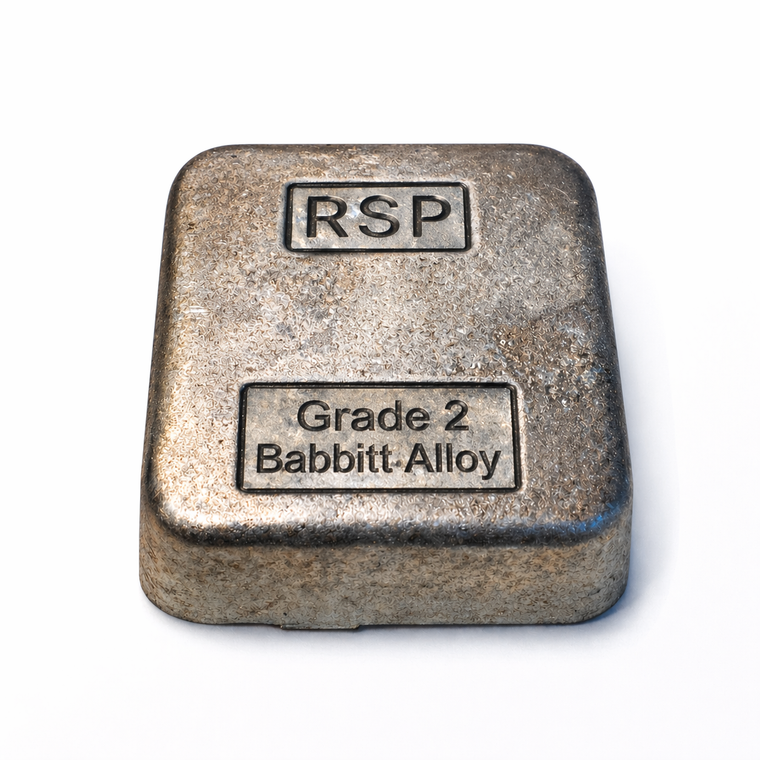
Grade 2 High-Speed Nickel Babbitt Alloy – 4X
Tin-Based Bearing Alloy | Approximately 1 lb Ingot | Sold Individually | Lead-Free
Rock Shot Products Grade 2 High-Speed Nickel Babbitt, commonly referred to as 4X Nickel Babbitt, is a premium tin-based bearing alloy intended for bearing repair, rebuilding, restoration, and other demanding bearing applications.
This alloy is based on a traditional Grade 2 tin-based Babbitt formulation consisting primarily of tin with antimony and copper, along with a small nickel addition characteristic of the 4X formulation.
Each ingot weighs approximately 1 pound and is sold individually, making it convenient for both individual bearing repairs and larger projects.
Product Specifications
Alloy Type: Grade 2 High-Speed Nickel Babbitt (4X)
Base Composition: Tin / Antimony / Copper
Tin (Sn): Approximately 89% nominal base composition
Antimony (Sb): Approximately 7.5% nominal base composition
Copper (Cu): Approximately 3.5% nominal base composition
Nickel (Ni): Minor alloying addition in the 4X formulation
Lead Content: Lead-Free
Form: Solid Cast Ingot
Approximate Ingot Weight: 1 lb
Sold By: Individual Ingot
Minimum Purchase: 1 Ingot
Solidus (Melting Begins): Approximately 466°F
Liquidus (Fully Molten): Approximately 669°F
Typical Pouring Temperature: Approximately 795°F
Primary Use: Bearing lining, rebuilding, repair, and restoration
Origin: Made in the USA
Individual ingot weight, dimensions, and appearance may vary slightly due to the casting process. Composition and working temperatures are nominal and may vary according to the specific alloy specification and application.
Why Choose Grade 2 High-Speed Nickel Babbitt?
Tin-based Babbitt alloys have a long history of use as bearing materials. Their metallurgical structure combines a relatively soft tin-rich matrix with harder intermetallic phases created by the alloying elements.
The 4X formulation incorporates a small nickel addition along with tin, antimony, and copper and is intended for applications requiring a high-quality tin-based bearing material.
It is particularly useful for customers rebuilding, resurfacing, or restoring poured Babbitt bearings in industrial machinery and equipment.
Common Applications
- Babbitt bearing rebuilding
- Bearing lining and resurfacing
- Bearing repair and restoration
- High-speed rotating equipment
- Industrial machinery
- Motors and generators
- Pumps and compressors
- Vintage machinery restoration
- Equipment restoration
- Specialty bearing applications
Convenient 1 lb Ingot Format
Rock Shot Products supplies Grade 2 High-Speed Nickel Babbitt in approximately 1-pound cast ingots, providing a practical size for bearing repair, restoration, and production work.
The smaller individual ingot format provides several practical advantages:
- Easy to handle and weigh
- Convenient to stack and store
- Better control over the amount added to a melting pot
- Allows smaller quantities to be melted as needed
- Simple to add to common melting pots and vessels
- Convenient for individual repairs as well as larger projects
Rather than requiring customers to purchase or work with a large individual bar, the approximately 1-pound format makes it easier to select the amount of Babbitt needed for a particular job.
How Quantity Works
This product is priced and sold by the approximately 1-pound ingot. Customers may purchase as little as one ingot.
Quantity 1 = approximately 1 lb
Quantity 5 = approximately 5 lb
Quantity 10 = approximately 10 lb
Individual ingot weights may vary slightly due to the casting process.
Melting & Bearing Preparation
Successful Babbitt bearing work depends on proper surface preparation, temperature control, tinning and bonding procedures, and appropriate pouring techniques.
The alloy begins melting at approximately 466°F and is fully molten at approximately 669°F. A typical pouring temperature is approximately 795°F, although actual working conditions can vary depending on bearing size, equipment, repair procedure, and application.
Customers should follow the appropriate bearing-repair procedures, equipment specifications, and temperature requirements for their particular application.
Need Larger Quantities?
Rock Shot Products supplies Babbitt alloys and specialty metals for individual, commercial, repair, restoration, and industrial customers.
If you require larger quantities or recurring supply, contact us for volume pricing and availability.
Rock Shot Products
Rock Shot Products supplies Babbitt metals, casting alloys, solder bars, specialty metals, and hard-to-find materials for commercial, industrial, and individual customers.
Made in the USA.
Safety Notice: Use appropriate ventilation and personal protective equipment when melting or casting metal. Avoid inhaling metal fumes or dust and follow applicable workplace, environmental, and safety requirements.